




Product Description
Introducing Langavant method for determine the heat of hydration of cements.
Langavant method consists of introducing a fresh cement speciment into a isolated Dewar flask and monitoring the temperature changes within the specimen during the first early days.
After a certain time, the heat of hydration of the cement content in the sample is equal to the sum of the heat accumulated in the flask and the heat emitted to the environment during the test period.
The temperature of the mortar is compared with the temperature of a inert sample placed in a reference calorimeter flask .
The amount of heat achieved by the cement mortar is mainly dependent on the nature thereof, and may reach values ??between 10 ° C and 50 ° C.
The amount of heat is expressed in joules per gram of cement.
Needed equipment
To perform the test you need:
- Calorimetric test bottle, designed to contain the sample of cement mortar.
- Calorimetric reference bottle, containing a mixed mortar at least 12 months before and is considered inert. If not available, use an aluminum cylinder of the same thermal capacity of the sum of mortar box and mortar sample.
- A mortar box (disposable after each test)
- Two thermometers or temperature recorder
- A planetary mixer according to EN 196-1
Test conditions
- The temperature of the test room must be 20 ± 2 ° C.
- Near the calorimeters, the ambient temperature must be between 19 and 21 ° C and remain stable within ± 0.5 ° C.
- Room temperature measurement is obtained using the reference calorimeter.
- The ventilation air velocity in the vicinity of calorimeters must be less than 0.5 meters per second.
- The heat sources and the ventilation openings near the calorimeters must be eliminated.
Specimen mortar composition
- Cement: 350 g
- Sand: 1050 g (must be normalized sand as per/ EN 196-1)
- Water (distilled): 175 g
- Total weight: 1575 g
The most common is to perform multiple tests simultaneously. In this case it uses a reference bottle for testing up to 6 calorimeters.
Make an hexagonal arrangement with the reference calorimeter in the center and respecting equal distance between them.
Calorimeter bottle features
For good results, the calorimeter bottle must be perfectly calibrated and meet all requirements of the test standard EN 196-9.
In order to perform the calculations of the standard procedure, each IBERTEST Langavant calorimeter bottle is checked and verified individually and incorporates a plaque indicating:
- heat loss coefficient
- calorific mass
Each bottle is delivered with its individual calibration certificate, made ??and issued by the “Laboratoire Regional de Ponts et Chaussees”
Dewar Flask Features
Made of plated borosilicate glass with hemispherical bottom
Includes an insulating cap and a rubber disc of 85 mm diameter and 20 mm thick, which supports the sample container and distributes the load evenly against the glass wall.
- Inner Diameter: 95 mm
- Outer diameter: 120 mm
- Depth: 280 mm
Dewar Flask housing
Ready to be placed inside the Dewar described above.
Made of duralumin (3 mm thickness), high rigidity and sturdy wide base ensures good stability.
The Dewar flask is separated from the sidewalls of the housing by an air gap of about 5 mm and rests on a support of about 50 mm thick.
The upper edge of the glass Dewar is in contact with a cap, crown-shaped, 5 mm thick, being so tied up in its accommodation. The crown locking provides a support surface of the glass stopper and ensures tightness.
Both the glass support and the crown-locking are made of very low thermal conductivity material.
Insulating cover, divided in 3 parts
- Lower part: It’s inserted into the vessel and limit heat loss.
- Central part. Consists of a disc made of foam rubber, 120 mm in diameter, which ensures the tightness of the calorimeter.
- Upper part. It consists of a hard case, with locking device that compresses the foam rubber disc of the central part, ensuring the sealing of the lid and the correct positioning of the cover of the Dewar flask.
Mortar Box
The mortar box is a capped cylindrical box, suitable for content the cement sample during the test, the mortar box is disposable after each test.
IBERTEST mortar boxes are made of tinplate of 0,3 thickness, electrically weld.
Features:
- Diameter: 80 mm
- Heigth: 165 mm
- Aprox. capacity. 800 cm3
- Water-vapourtight at 0,3 bar pressure
In the middle of the cap, there is a cylindrical thermometer box, closed at the bottom. The inner diameter of the box is slightly larger than the diameter of the thermometer.
The length can vary from 100 to 120 mm, so that the thermometer box can reach the heart of the test tube.
The mortar box must be absolutely water-vapourtight. The water-vapourtightness is controlled by weighing the mortar box after each test.
Temperature probe
IBERTEST temperature probes are resistance type Pt 100 (100 ? platinum), isolated with a plastic film of very low thermal conductivity.
Each probe is provided with a ENAC calibration certificate. The ENAC certification is widely recognized. The verification is issed with calibrated instruments, traceable to international temperature standards.
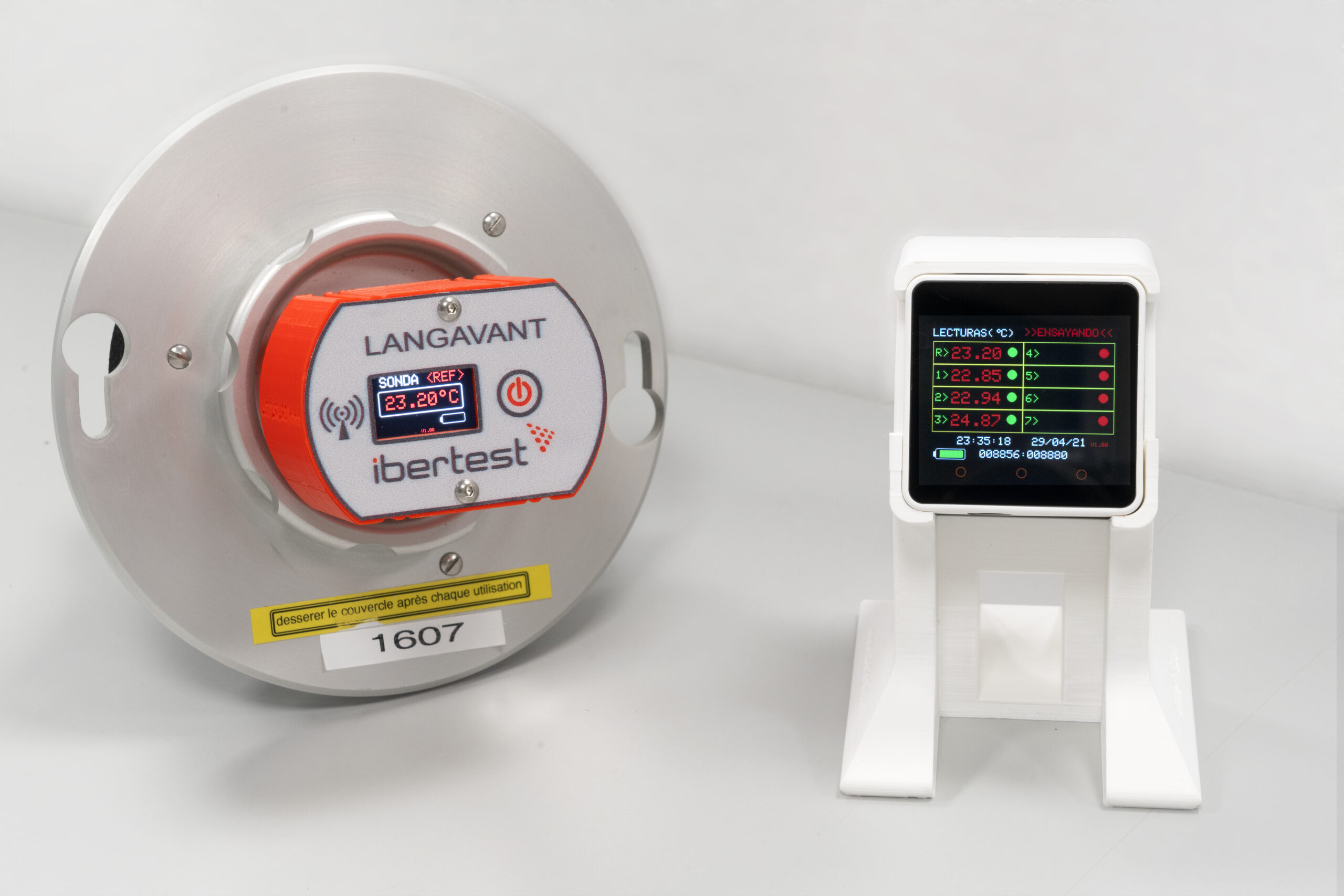
Wireless data acquisition module
8 measuring channels for connecting up to 8 wireless temperature probes type Pt 100 (1 for the reference bottle temperature probe and 7 free channels, for connecting up to seven probes)
Technical features:
- USB output (charger and connection) or ETHERNET for connection to a computer.
- Wireless distance up to 30 metres (depending on the location of the probes).
- Lithium battery for 3 hours autonomy.
- Battery charge indicator, low battery sound indicator, as well as charger (power supply) indicator, whether or not it is connected to the equipment.
- Date and time indications, used to record the data from the probes (DataLogger).
- 2.0″ colour display, resolution 320×240 pixels.
- SD memory card slot.
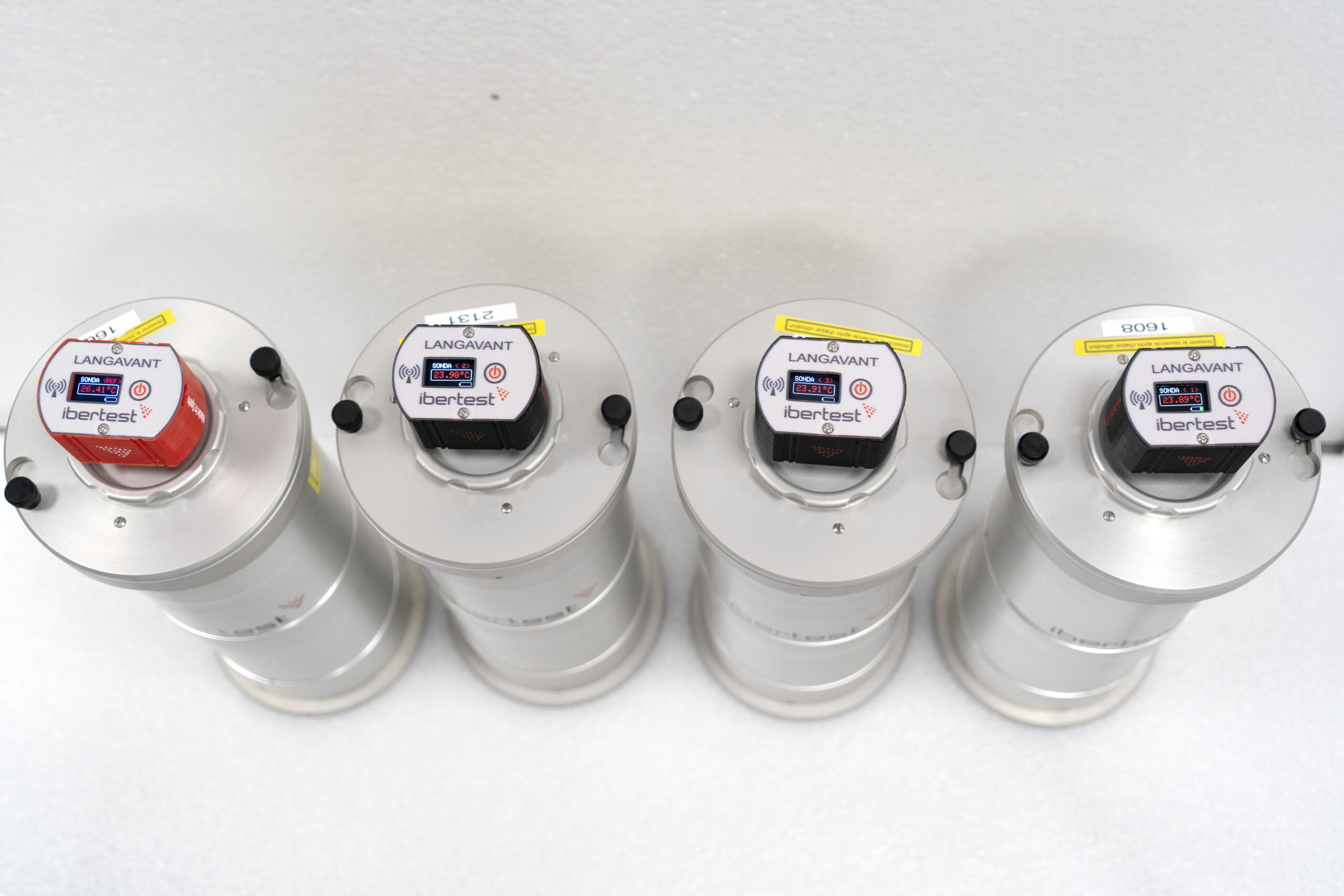
Wireless probe
Technical features:
- 16-bit resolution.
- ADC delta-sigma accuracy of 0.05% Max. full scale.
- PT100 Platinum four-wire RTD probe PT100 Platinum high accuracy 1/10.
- Error code according to type of fault with PT100 probe.
- Temperature conversion time 21ms.
- Adjustment and calibration is stored in the instrument.
- Lithium battery for 3 hours battery life.
- Battery charge indicator, as well as charger (power supply) indicator, whether or not it is connected to the device.
- 1.14″ colour screen, resolution 135×240 pixels.
WinLect32 data acquisition software, running on Windows.
- Fully developed by IBERTEST for the Langavant test.
- Suitable for measuring up to 8 channels at the same time.
- Allows a continuous reading of the reference heat and the amount of heat transmitted by the samples placed in the test.It calculates the hydration heat of each sample showing the test results graphics according with the standard
- Full free parameterization of tests, samples data, etc.
- Real time graphics for temperature/time.
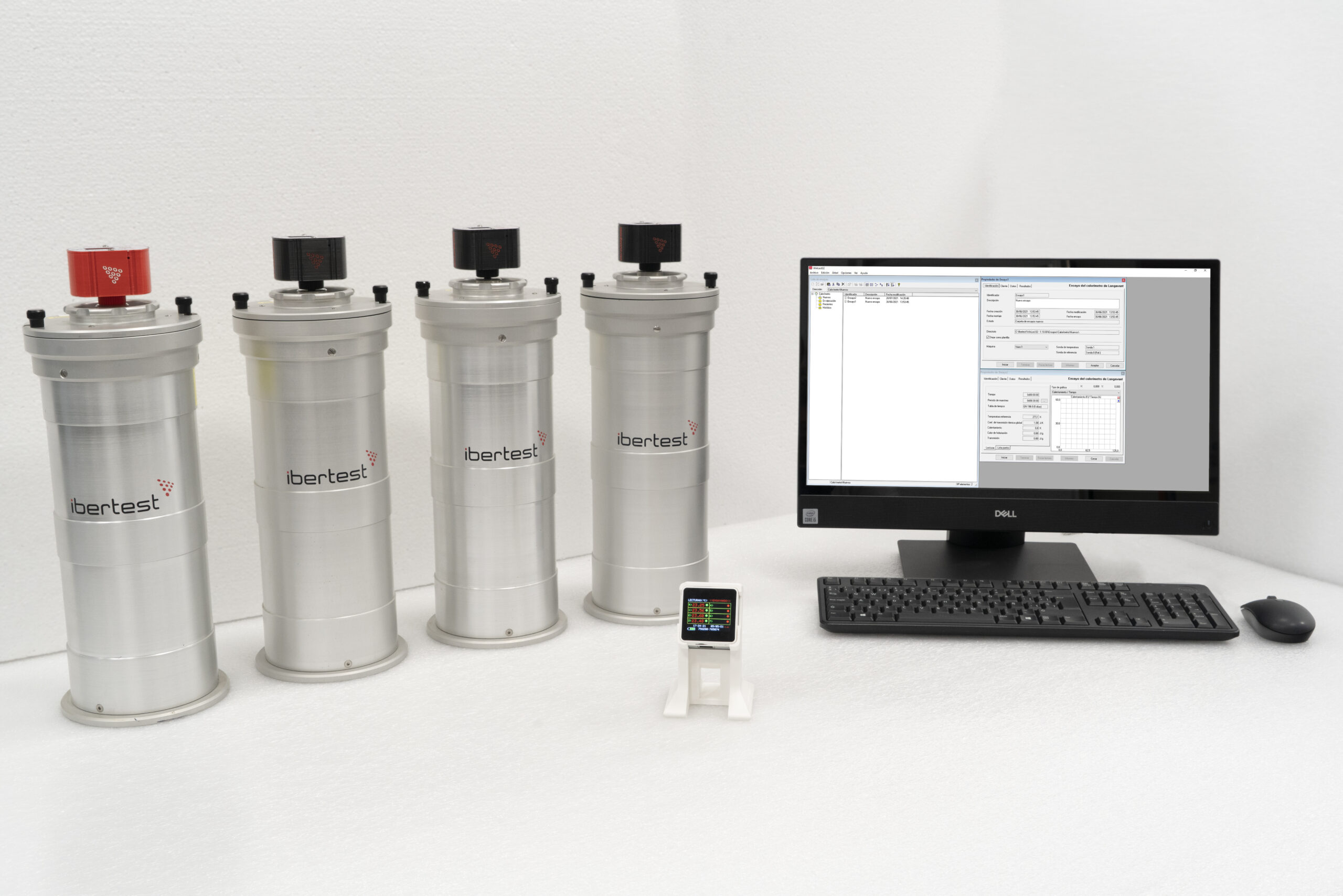
The minimum configuration includes the following elements:
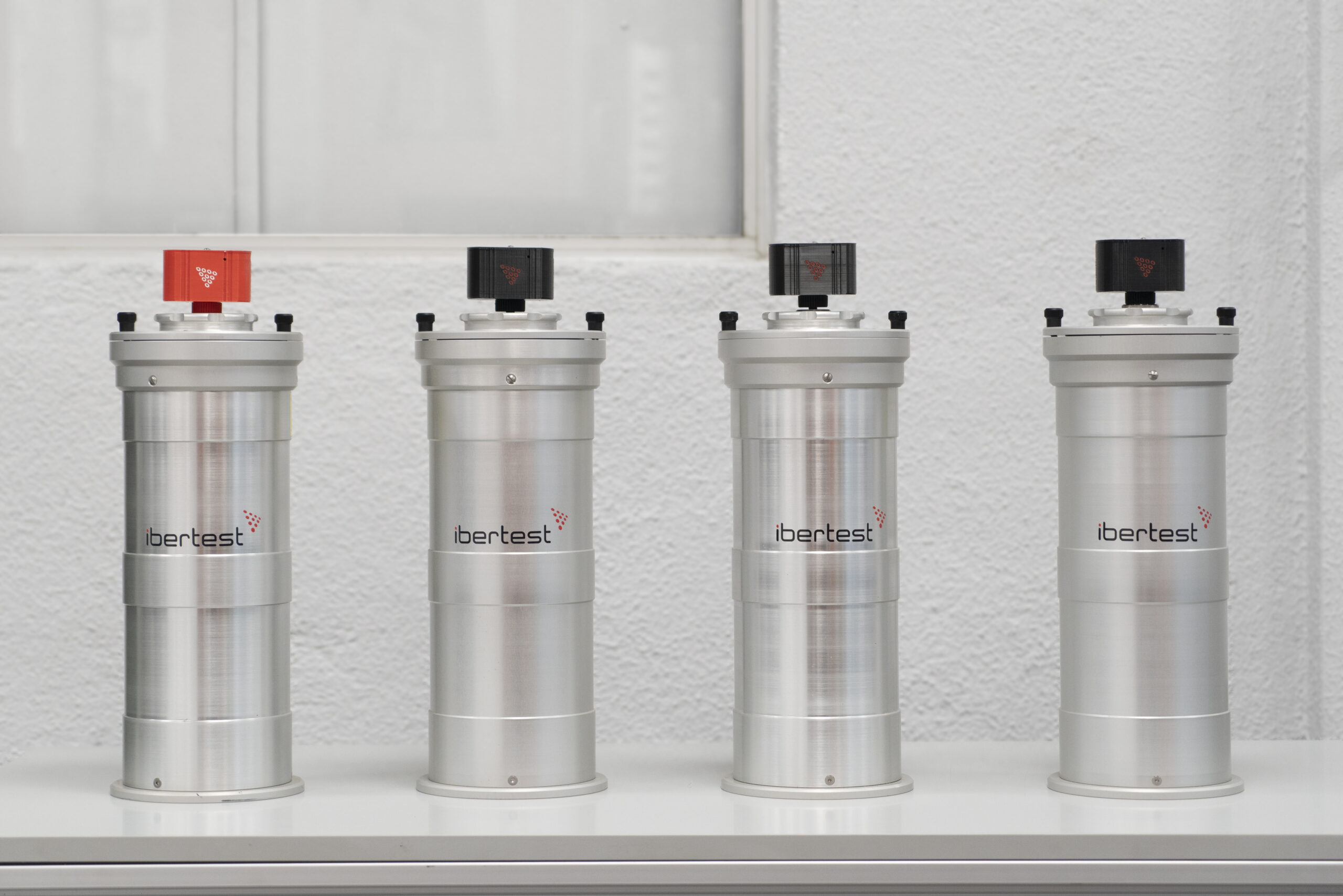
- Set of 2 isolated calorimeter bottles (one for reference), supplied with official calibration certificate.
- Set of 2 wireless temperature probes type Pt-100, 4-wire, high precision 1/10, with calibration certificate, issued by ENAC accredited laboratory.
- Set of 50 mortar pots, disposable after each test.
- Data acquisition module with 8 input and output channels USB (charger and connection) or Ethernet. Allows connection of up to 8 calorimetric bottles (7 for testing + 1 for reference).
- State-of-the-art computer, keyboard, mouse, 23.8″ screen, Windows with manuals and licences.
- IBERTEST WinLect32 software licence, under Windows®, pre-installed on the supplied PC.
Optional accessories
- Additional isolated calorimeter bottles, supplied with official calibration certificate. Ref. 210-102361
- Aditional wireless temperature probe type Pt-100, with ENAC calibration certificate.
- Set of 50 mortar pots, disposable after each test. Ref. 210-100000
- Aluminum cylinder: to be used as reference instead of the inert cement. Ref. 210-104099


